
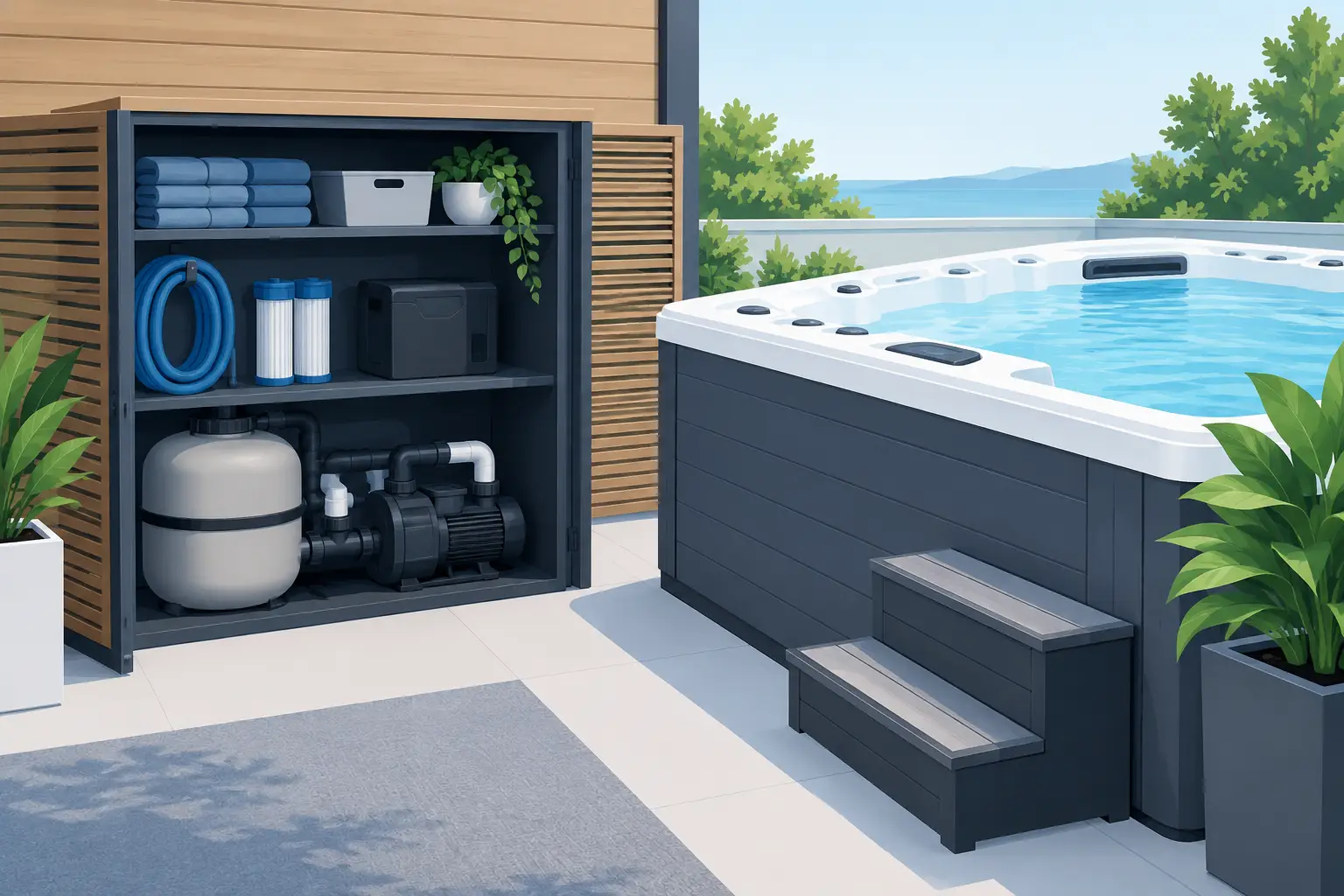
A swim spa can be the centerpiece of a well-designed backyard, but the area around it often collects towels, water-care supplies, resistance gear, covers, and everyday clutter. To organize swim spa equipment well, think beyond finding a place to put things. The goal is to create a space where every item is easy to reach, protected from the weather, and stored in a way that supports safe movement around the water.
A polished setup should feel intentional from the first step out the back door. When storage, seating, entry steps, and accessories work together, your swim spa area becomes easier to maintain and more enjoyable to use for exercise, recovery, family time, or entertaining.
Start by Separating Equipment by Use
The quickest way to create order is to avoid treating all swim spa accessories the same. Equipment used every day should not be stored like seasonal items, and chemicals should never share space with damp towels or pool toys.
Begin by grouping what you own into practical categories: water-care supplies, towels and personal items, workout equipment, cleaning tools, and seasonal accessories. This simple review often reveals what is taking up space without adding value. Expired products, duplicate tools, damaged floats, and rarely used accessories can be removed before you invest in storage.
Your most frequently used items deserve the most convenient locations. Keep fresh towels, hand towels, cover lifter accessories, and regularly used training gear near the entry point. Brushes, nets, vacuums, extra filters, and winter accessories can be kept in a secondary storage location that remains accessible without occupying prime space beside the swim spa.
Give Water-Care Supplies Their Own Secure Zone
Chemical storage requires more care than any other category. Sanitizers, shock treatments, test strips, and balancing products need a dry, shaded, well-ventilated place away from direct sun, heat sources, children, and pets. Keep every product in its original labeled container, and follow the storage directions supplied by the manufacturer.
A dedicated weather-resistant cabinet is often the right choice for this zone. Select a unit with a secure door and enough interior room to keep containers upright rather than stacked. Spills are easier to spot and manage when products are not crowded together. It is also wise to keep a small, clearly marked bin for test strips, measuring tools, and protective gloves so routine water care does not turn into a search through several containers.
Do not store chemicals underneath towels, cushions, or workout accessories. Even a tightly closed container can introduce odors or residue into a shared storage space. A separate cabinet is a safer, cleaner solution and makes weekly maintenance feel much more manageable.
Create a Dry Landing Place for Towels and Personal Items
The space immediately outside a swim spa sees the most traffic. Swimmers need somewhere to set a towel, sandals, a robe, water bottle, or phone before getting in. Without a designated landing place, those items end up on steps, railings, or the patio, where they create clutter and can become a slip hazard.
A small outdoor table near the entry provides a convenient surface for personal items. For households that use the swim spa often, a coordinated storage bench or cabinet can hold extra towels while providing a finished furniture element. The best choice depends on how your family uses the space. A compact table may be sufficient for two adults, while an active household may benefit from enclosed storage with more capacity.
Choose materials that are designed for outdoor exposure. Furniture-grade recycled HDPE is particularly well suited to spa areas because it resists moisture, does not require painting or staining, and is easy to maintain. It also offers a more substantial, tailored appearance than lightweight plastic storage solutions that can fade, crack, or shift in the wind.
Organize Swim Spa Equipment Around Safe Movement
Convenience matters, but clear pathways matter more. The route from the house to the swim spa, along with the area around the steps, should remain open at all times. Avoid placing storage bins, loungers, or exercise equipment where someone may need to walk with wet feet.
Start with the entry and exit point. Your steps should provide stable access, and any surrounding furniture should leave room for a person to enter and exit comfortably. If you use a handrail, cover lifter, or assist bar, account for its operating space before choosing a cabinet or table location. A storage piece that looks well positioned when the spa is closed may interfere with cover removal when it is open.
This is where custom planning can make a visible difference. Swim spas vary considerably in length, height, cabinet design, cover configuration, and placement within the yard. A storage arrangement that works beside one model may be awkward beside another. Measure the full footprint, including steps, cover clearance, doors, and walking paths, before selecting furniture.
Choose Storage That Belongs in the Backyard
Outdoor storage should support the appearance of your investment, not compete with it. Mismatched plastic totes and utility shelves may solve a short-term problem, but they often make a premium swim spa setting feel unfinished.
Look for storage that coordinates with your swim spa cabinet, decking, patio furniture, or home exterior. Color matching can make steps, tables, surrounds, and storage elements read as one cohesive outdoor room. This is especially valuable when the swim spa sits near a patio, pergola, outdoor kitchen, or landscaped entertaining area.
Durability is equally important. Storage located beside a swim spa is exposed to moisture, changing temperatures, cleaning splashes, and regular use. Weather-ready materials should be easy to wipe clean and built to hold their shape through the seasons. Hinges, handles, and lids deserve attention as well. These small details are often the first to show wear on lower-quality outdoor products.
There is a trade-off between open and enclosed storage. Open shelving gives you faster access to rolled towels and frequently used gear, but it requires consistent tidying and offers less weather protection. Enclosed cabinets look cleaner and protect contents more effectively, although they may not be ideal for items that need airflow after use. Many homeowners get the best result by using both: enclosed storage for supplies and an open or ventilated area for drying towels and gear.
Plan for Fitness Accessories Without Creating Clutter
Swim spa fitness equipment can accumulate quickly. Resistance bands, paddles, aquatic dumbbells, kickboards, ankle cuffs, and flotation items are useful, but loose gear can take over the patio. Give these accessories a defined home close to the swim side of the spa, separate from chemical storage and dry linens.
A lidded bench or cabinet works well for lightweight workout equipment, particularly when the interior can be divided into bins. Use one bin for bands and small accessories, another for floating equipment, and a third for cleaning supplies that are safe to store together. Labels are helpful when several family members use the swim spa, but the real advantage comes from making the return location obvious.
Allow wet equipment to dry before closing it inside a cabinet for long periods. If your household uses the swim spa for frequent training, a drying rack or designated hooks in a covered area may be more practical than placing everything into enclosed storage immediately. The right answer depends on your climate, how often the spa is used, and whether the equipment is shared by multiple swimmers.
Build a Simple Reset Routine
Organization lasts when it is easy to maintain. A complicated system will usually be abandoned after a busy week, while a simple reset routine keeps the area ready for the next use.
After each session, return equipment to its assigned location, hang wet towels to dry, and clear the steps and walking path. Once a week, wipe down tables and cabinet surfaces, check that chemical containers are sealed, and restock towels or test strips. At the change of seasons, review the entire storage area and move rarely used items out of the immediate spa zone.
This routine also gives you an opportunity to notice small issues before they become frustrating. A lid that is difficult to open, a cabinet that has become overcrowded, or a table positioned too close to the cover lifter can be corrected early. Good organization should make ownership easier, not introduce another maintenance task.
Let the Layout Reflect How You Use Your Swim Spa
The best swim spa area is not necessarily the one with the most storage. It is the one that supports your routine without making the deck or patio feel crowded. A family that uses the spa for evening relaxation may prioritize towel storage, drinks, and safe entry. A dedicated fitness user may need more room for training accessories and equipment drying. Homeowners who entertain may place greater value on coordinated tables, seating, and a refined visual presentation.
A&B Outdoor Products has built its reputation on helping spa owners create practical, tailored surroundings with durable, USA-made accessories. When storage, steps, tables, and surrounding elements are selected as part of one plan, the result is easier access, a cleaner outdoor setting, and a swim spa area that feels finished every day you use it.
Start with the items you reach for most, protect the essentials that need secure storage, and preserve clear space where people move. That thoughtful balance is what turns swim spa equipment from visible clutter into a well-managed part of your outdoor living space.
